High-Risk Food Processing Guide for Food Businesses
Food processing can range from simple, low-risk activities, such as producing baked goods, to higher-risk processes like canning or processing meats. While all food processing carries some level of risk, higher-risk activities require additional controls to ensure food is safe for sale to the public.
This guide is intended for food business operators who plan to process food products for sale, particularly those involved in higher-risk food processing.
What is food processing?
Food processing refers to the methods used to transform raw ingredients into food products that are safe to eat, store, or sell. This can include physical, chemical, or biological processes that affect food safety, shelf life, and quality.
Food processing activities may include:
- Preparation, such as washing, chopping, or peeling
- Cooking, such as baking, boiling, or frying
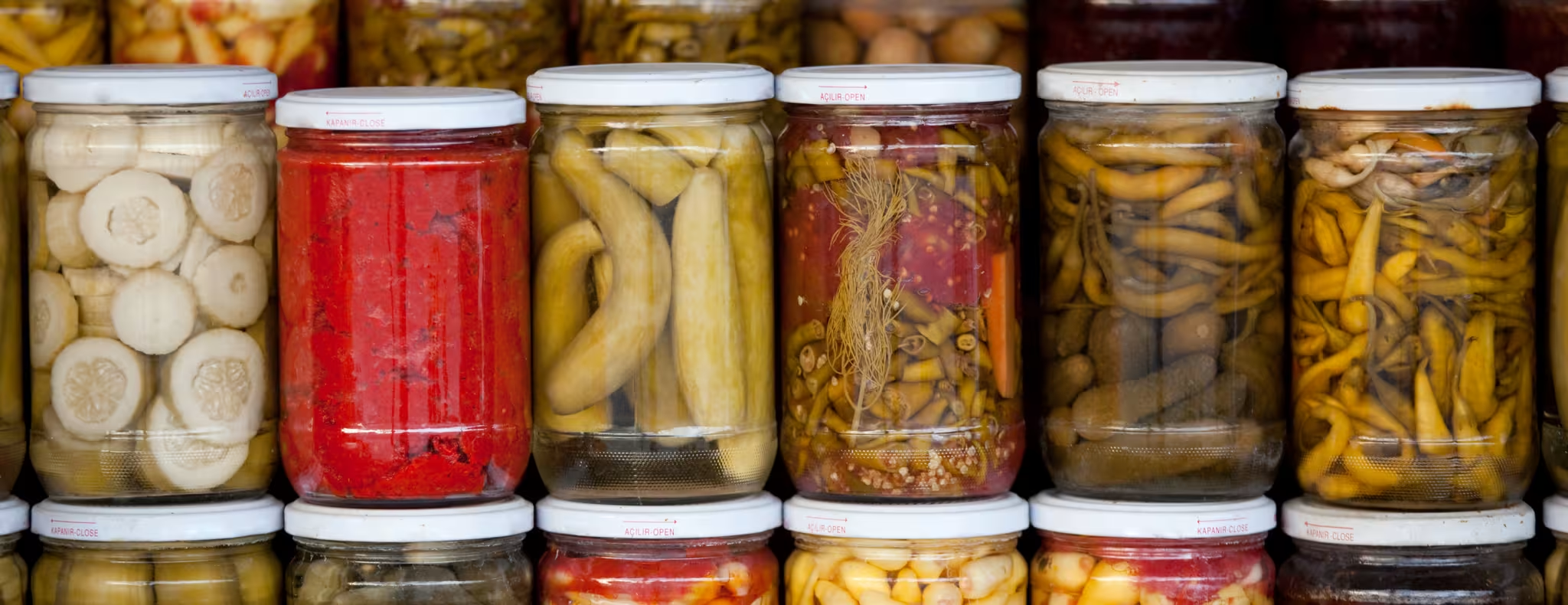
- Preservation, such as canning, freezing, or drying
- Fermentation
- Packaging and storage, including vacuum sealing or pasteurization
- Smoking of foods such as meat or fish
Some processed foods can be sold without time and temperature control, while others require strict controls due to higher food safety risk.
Understanding food safety risk
Higher-risk food processing typically involves foods that support the growth of harmful bacteria if not properly controlled. Factors that influence food safety risk include:
- Acidity (pH)
- Water activity (Aw)
- Temperature
- Processing method
- Shelf stability
Foods sold without refrigeration or other temperature control require particular attention to these factors to ensure they are safe for consumers.
Food Safety Requirements
The following requirements apply to the sale of processed, canned or bottled foods. It is the responsibility of the owner or producer to ensure all applicable industry standards and CFIA requirements are met for both processing and labelling.
The following requirements apply to the sale of processed, canned, or bottled foods. It is the responsibility of the owner or producer to ensure all applicable industry standards and CFIA requirements are met for both processing and labelling.
Where products can be prepared
- All processed and packaged foods sold to the public at retail stores, farmers’ markets, and special events must be prepared in an inspected facility.
- This requirement does not apply to exempt farmers’ markets and special events that meet the criteria outlined in the Ontario Food Premises Regulation.
- Inspections and approvals must be completed by WDG Public Health before products are sold to the public.
Labelling requirements
All packaged food items sold at retail outlets must include, at minimum:
- Product name
- Producer name and contact information
- Ingredient list
- Packaged date
- Any required safe handling instructions, storage instructions, expiry or best before date and allergy alerts
Additional or different labelling requirements may also apply under federal regulations. For more information, visit Food labelling for industry on the Canadian Food Inspection Agency website.
Type of products
Non-refrigerated, high-risk, low-acid canned or bottled foods require additional controls to prevent the growth of harmful bacteria, including Clostridium botulinum.
The following requirements apply.
- Supporting documentation: Documentation must be provided to demonstrate that the product is shelf stable and it is the responsibility of the owner or operator to demonstrate that the product has been rendered safe. Documentation must include:
- Laboratory analysis completed by a qualified laboratory showing:
- pH level and or
- Water activity (Aw)
- A validated recipe.
- If an existing recipe is used, it cannot be modified without notifying Public Health.
- Laboratory analysis completed by a qualified laboratory showing:
- Approved processing methods
- Products must be prepared using a pressure canner capable of reaching temperatures required to destroy Clostridium botulinum spores.
- All low-acid food processing must use:
- A scientifically validated recipe, and
- A pressure canner capable of reaching 116–121°C (240–250°F) for 20–100 minutes, depending on the product.
Acidified foods are foods that have been processed to lower the pH.
Best practices and requirements include:
- Supporting documentation must be provided to demonstrate shelf stability.
- Laboratory analysis by a qualified laboratory must confirm pH and or water activity (Aw).
- The owner or operator is responsible for demonstrating that the product has been rendered safe.
- Supporting documentation must include a validated recipe.
- Existing recipes cannot be changed without notifying Public Health.
- Ongoing testing during production must be completed and recorded for pH and or water activity.
- A Public Health Inspector may conduct a risk assessment to determine testing frequency.
Low-risk, high-acid foods present a lower food safety risk when prepared properly.
Best practices include:
- Using an existing validated recipe is recommended.
- Routine testing is not required when a validated recipe is used.
- If using your own recipe:
- A Public Health Inspector will confirm adequate processing, and
- Testing may be required.
- If a canned or bottled product is intended to be sold as requiring refrigeration, it must be clearly labelled as such.
- These products do not require testing, unless determined otherwise through a Public Health Inspector’s risk assessment.
- This does not apply to high-risk, low-acid foods.
- An expiry or best before date may still be required under CFIA requirements.
| Low-Risk / Non-hazardous Foods | Acidified Foods | High-Risk / Hazardous Foods |
|---|---|---|
High-Acid Foods
| Foods that have gone through processing, resulting in a finished product with a pH of 4.6 or below and water activity greater than 0.85. | Low-Acid Foods
|
|
|
|
Resources
If you are performing Category 2: High-Risk Activities for meat processing (manufactured meats), you are subject to the applicable sections of the Food Premises Regulation.
These activities include, but are not limited to:
- Canning, dehydrating or emulsifying meat
- Curing, fermenting or smoking meat
Where your process includes a Category 2 activity, the following requirements apply.
1. Validated recipes and processing controls: Use a validated recipe from a reputable source that clearly identifies:
- Measured ingredients
- Processing time
- Processing temperature
- Relative humidity
2. pH and water activity requirements
- For jerky and fermented meat products, the final pH and water activity (Aw) must meet at least one of the following criteria to destroy harmful bacteria and achieve a shelf-stable product:
- pH less than 4.6, or
- pH between 4.6 and 5.3 and water activity (Aw) between 0.9 and 0.85, or
- Water activity (Aw) less than 0.85
3. Whole muscle dried cured meats
- Whole muscle dried cured meats must be:
- Fully coated with salt, and
- Held at 0–4°C for a minimum of two weeks
- Once fully cured, the product must contain a minimum of 2.5% salt to achieve a shelf-stable state.
- Once the meat product is sliced, it must be refrigerated to prevent bacterial contamination.
4. Food safety procedures and documentation
- Written food safety procedures must be created and implemented.
- These procedures must be approved by a Medical Officer of Health or Public Health Inspector.
- Documentation must be maintained for:
- Time
- Temperature
- Relative humidity
- pH
- Water activity (Aw)
5. Additional regulatory considerations
- Your facility may also be subject to requirements under the Ministry of Agriculture, Food and Agribusiness.
- Operators are encouraged to follow up with OMAFA to ensure compliance where applicable.
Resources
Food safety planning and HACCP
Using a HACCP-based (Hazard Analysis and Critical Control Points) approach is strongly recommended for higher-risk food processing operations.
A HACCP approach helps identify and control risks related to factors such as temperature, pH, water activity, and processing steps. Depending on your operation, a Public Health Inspector may advise which controls and records are appropriate.
Learn more:
- What is HACCP?
- HACCP Principles & Application Guidelines
- About Hazard Analysis Critical Control Point
- How to Write a HACCP Plan
Using a co-packer
Some food businesses choose to work with a co-packer, a company that manufactures and packages food products on behalf of another business.
If you use a co-packer:
- Notify Wellington-Dufferin-Guelph Public Health when starting or changing operations
- Ensure the co-packer’s facility is inspected and approved by the appropriate health authority
- Maintain oversight of food safety and regulatory requirements related to your product
Using a co-packer may be an option for businesses that do not have the capacity or equipment to safely produce higher-risk foods in their own facility.